Girl in a Wetsuit statue is located on a rock in the water along the north side of Stanley Park in Vancouver. It is a life-sized bronze sculpture of a woman in a wetsuit, with flippers on her feet and her mask pushed up on her forehand. The statue was made in 1972 by a Hungarian sculptor, Elek Imredy, whom immigrated to Vancouver in 1957. Elek Imredy fled from Hungary in 1956 and settled in Vancouver in 1957. He first taught evening courses at the Vancouver School of Art and Vancouver City College (which is now known as Langara), and not too long later, Elek became one of Vancouver's noted professional sculptor and he was one of the founders of the Western chapter of the Canadian Sculptor’s Society. During his career, Elek created many sculptures which include the Lady of Justice at the Vancouver Law Courts and a life-sized statue of Prime Minister Louis St. Laurent in the Supreme Court in Ottawa. One of Elek most famous sculpture is Girl in a Wetsuit.
Postings by Christine Chan, Sarah Fitzmaurice, Gary Jarquin, and Geoff Whiteley from BCIT's LIBS 7027 course will included views on how Vancouver’s climate and location have shaped it into the city it is today, the history and relevance of some of Vancouver’s signature landmarks (natural and manmade), and the significance these items have for Vancouverites.
Sunday, 11 August 2013
Vancouver: A City of Neighborhoods
Vancouver is the ever-growing coastal seaport city located on the South-West corner of mainland British Columbia. The original settlement established in 1867, named Gastown grew around the Hastings Mill. It eventually grew to become the townsite of Granville before being renamed Vancouver as it was incorporated as a city in 1886. As the city grew, smaller communities started becoming more evident and Vancouver became a city of neighborhoods. There are now 21 distinguished neighborhoods in Vancouver, and although the actual borders between them are inexact, they each have their own unique character.
Separated into sections of Central Vancouver, West Side, East Side and South Vancouver a brief overview of the neighbourhoods will be give. As previously mentioned the actual borders are inexact and are occasionally merged into sub-neighbourhoods or into more than one of the 4 directional quadrants.
Friday, 9 August 2013
Inukshuk
Inukshuk, is a mysterious stone figures that can be found throughout the world. They are monuments made of unworked stones that are used by the Inuit for communication and survival. An Inukshuk can be small or large, single rock or several rocks balanced on each other, round, bounders or flat. The arrangement of stones indicates the purpose of the marker. The Inuit make Inukshuk in different forms for a variety of purposes: as navigation or directional aids, to make a place of respect or memorial of a beloved person, or to indicate migration routes or places where fish can be found. These sculptural forms are among the oldest and most important objects placed by humans upon the vast Arctic landscape and have become a familiar symbol of the Inuit and of their homeland. Inuit tradition forbids the destruction of Inukshuk, it is often venerated as symbolizing ancestor who knew how to survive on the land in the traditional way.
Wednesday, 31 July 2013
The New Vancouver Convention Centre
The Vancouver Convention Centre West
The beautiful new expansion to the Vancouver Convention Centre certainly is a representation of the city and its values. Aspiring to be one of the "greenest" cities in the world, Vancouver's new convention centre certainly aids in that respect. The addition has added 220,500 square feet (20,490 m2) of convention space, 90,000 square feet (8,400 m2) of retail space and in total as a project 14 acres (57,000 m2) of land and 8 acres (32,000 m2) over water. In times past, an expansion of this size would signify major environmental impact, however the determination and dedication of all those involved ensured the project meet LEED Platinum standards, the highest achievement from LEED (Leadership in Energy and Environmental Design). Opened on April 4, 2009 the expansion tripled the capacity of the convention centre which fit well for the 2010 Winter Olympic and Paralympic Games as it hosted the International Broadcasters during that time. To date the events held have ranged from the XI International Conference on AIDS, hosting 15,000 delegates (its largest event) to a small meeting between Boris Yeltsin and Bill Clinton. While the convention centre provides large economic benefits to Vancouver by grossing $215 million in revenue, its significance as a landmark of Vancouver stretch more to the architecture and how it truly represents the city.
Thursday, 4 July 2013
Dr. Sun Yat-Sen Classical Chinese Garden
As we all know, Vancouver is a city that is full of diversity. The Dr Sun Yat-Sen Garden Society was incorporated in 1981 as a non-profit organization established to maintain and enhance the bridge of understanding between Chinese and Western Cultures, promoting Chinese culture generally and be an integral part of the local community.
Thursday, 27 June 2013
Vancouver Aquarium
Canada's largest aquarium is the Vancouver Aquarium. It has 70,000 animals with 150 aquatic displays. The facility specializes in Marine preservation and conservation.
The Vancouver Public Aquarium Association was formed in 1950 by UBC fisheries and oceanography professors Murray Newman. The Vancouver Aquarium was the first aquarium in the world to capture and display an orca. The orca in British Columbia is legendary and dates back to the ancient native's who roamed these lands centuries ago. The Vancouver Aquarium operates a Marine Mammal Rescue program which is aimed at rescuing and rehabilitating marine mammals that are found injured, ill, or abandoned, until they can be re-released into their natural habitats Preserving wild-life in British Columbia is what has made this province famous and has attracted tourists from around the world. Two hundred years ago, the waters that suround vancouver flourished whales - today thanks to organizations like the Vancouver Aquarium they are trying to keep this tradition alive, so future generations can see Vancouver in its natural beauty. This landmark is an example of the way Vancouver citizens want to preserve the tradition of the Orca and its accompanied marine wildlife that live of British Columbia.
The Aquariums indoor display marine life from the Georgia Strait and from other coastal areas of BC. They have sharks and sea turtles as well as fish from the Amazon Rainforest.
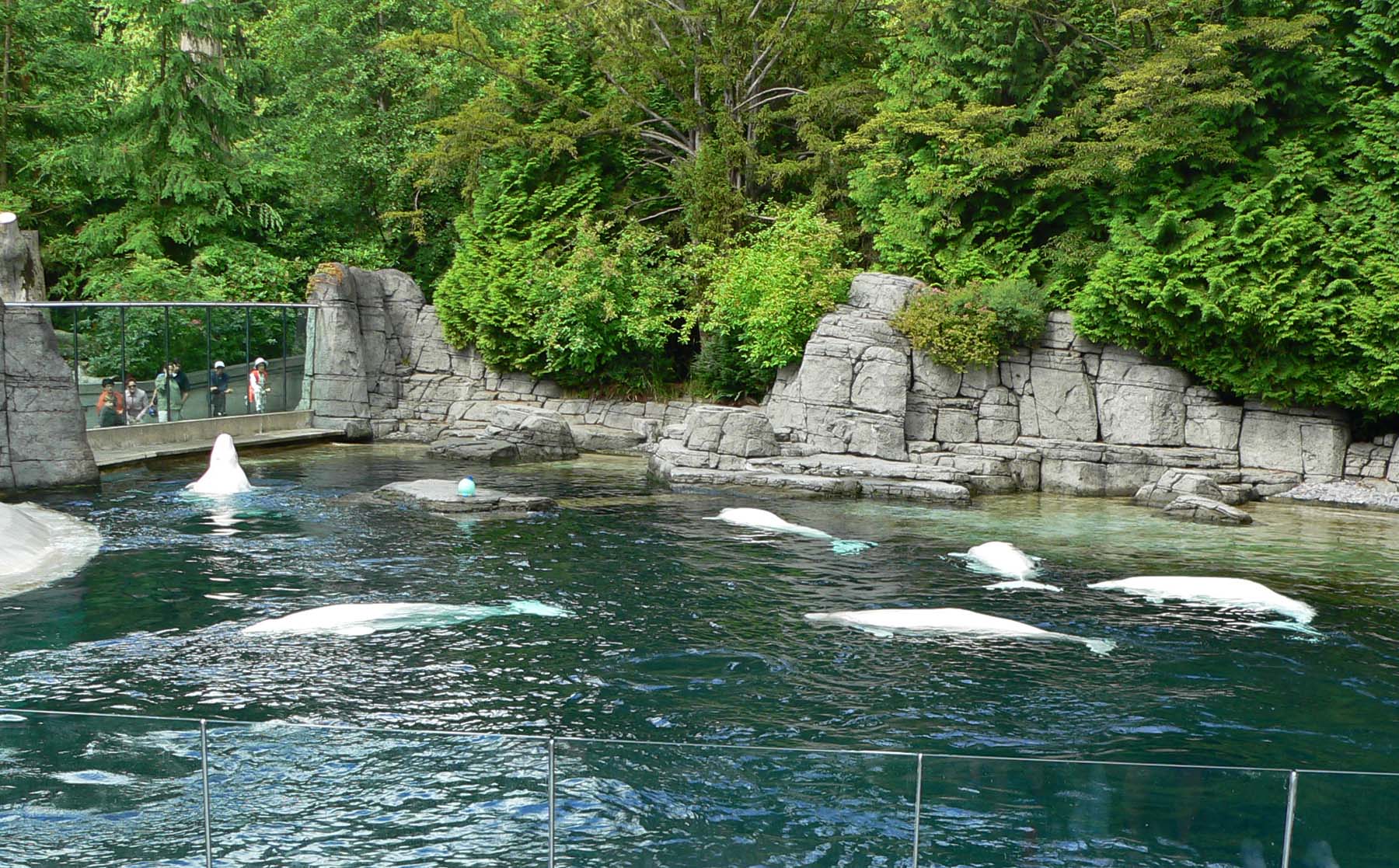
The outdoor display has Beluga whales, dolphins, sea lions, and sea otters. The tanks have indoor viewing windows to see the animals up close. The aquarium also display's South African penguins
The Vancouver Aquarium is located in Stanley Park.
Capilano Suspension Bridge
The famous Capilano Suspension Bridge is located at Capilano Suspension Bridge Park in North Vancouver. The park also has many other outdoor activities.
The bridge was originally built in 1889 by George Grant Mackay, a Scottish civil engineer. It was originally made of hemp ropes, and was replaced with a wire cable bridge in 1903. In 1910 Edward Mahon purchased the bridge, then in 1935 MacEachran purchased the bridge and invited local natives to place their totem poles in the park. It felt necessary to add some kind of native heritage to the bridge as it was lacking a personality. But the bridge formed its own identity throughout the 100+ years of its existence, it is now part of Vancouver's heritage.
The Capilano Suspension Bridge has been visited by people since 1889. Suspended 230 feet (70 metres) above the Capilano River, the Bridge spans 450 feet (137 metres) across. Below the bridge is a canyon. Crossing the bridge is scary as your feel the bridge sway left and right.
Capilano Suspension Bridge Park is an amusement park. You can view the rainforest via Treetops Adventures or venture into the Cliffwalk, a 700-foot long (213 metres), 300-foot high (91 metres) walkway anchored and suspended above the river.
The bridge is located at 3735 Capilano Road in North Vancouver. There are free shuttles that will take you to the Park from Canada Place.
Subscribe to:
Posts (Atom)